The AI-Advisors Platform module shipped May 2, 2026 and turns a Google Ads campaign's keywords and ad headlines into a ChatGPT Ads campaign in a single LLM call. Every keyword classifies into one of 5 Context Hint Patterns. Every conversion comes paired with an AI Visibility Lift content brief, so paid placement compounds with organic ChatGPT Ads citations. The verdict is honest. Below $25K spend triggers a 0.7 multiplier whether the campaign is good or not. The Platform module is the paid sibling of the Free converter; it saves campaigns, launches them to ChatGPT Ads paused, and pairs every conversion with content briefs for Content Studio.
- Where it lives: AI Ads → + Create → Import from Google Ads inside the AI-Advisors platform at app.ai-advisors.ai/dashboard/ads. To import Search campaigns straight from a connected Google Ads account, use the converter in the app.
- Plan tier: Growth ($99/month) and above. 15 saved campaigns. 14-day Stripe trial.
- Throughput per conversion: 30 keywords plus 20 ad headlines. Single LLM call. Typical 3 to 12 second response.
- 5 Context Hint Patterns: Persona + Intent, Question, Topic + Disqualifier, Outcome, Stack Comparison
- No account minimum on ChatGPT Ads since May 5, 2026 (was $50K Apr 13 to May 5; was $200K at launch); OpenAI documents a per-campaign daily minimum that varies by billing currency (US $25/day, September 2026). The Platform module's 0.7x spend multiplier still applies to sub-$25K spend buckets as a directional-signal quality flag.
The migration question every B2B marketer is asking
For three years, the question about conversational ads on ChatGPT was theoretical. The pilot tier sat at $200K, the inventory was opaque, and the platform mostly attracted holding-company creative teams running brand experiments. That changed three times in April-May 2026. On April 10, OpenAI shipped the self-serve Ads Manager. On April 13, the minimum dropped from $200K to $50K. On May 5, the platform opened to every US advertiser and the minimum was removed entirely. By that point, every B2B SaaS marketer running meaningful Google Ads spend was asking the same question: do my campaigns translate?
The translation math itself is not the hard part. Headlines, CPC bids, daily budgets, conversion events all map cleanly between the two surfaces. The hard part is the mental model. ChatGPT Ads does not match keywords. It matches user intent expressed in plain language. The bridge from "best CRM for sales teams" to "marketing leaders comparing CRM platforms for a 50-person team" is a translation step Google Ads marketers have never done before, because Google Ads has always rewarded the literal string.
The Platform module at app.ai-advisors.ai/dashboard/ads shipped May 2, 2026 to absorb that translation step. It takes the keywords and ad headlines from a Google Ads campaign, classifies every keyword into one of 5 Context Hint Patterns, drafts a ChatGPT-ready headline for each, and pairs each conversion with an AI Visibility Lift content brief that compounds the paid placement with organic AI citations. The rest of this post walks through what the module does, the math behind its verdict, and the 6-step workflow from sign-up to a campaign launched in ChatGPT Ads.
The 5 Context Hint Patterns
The first thing the converter does, before scoring or rewriting anything, is classify every input keyword into exactly one Context Hint Pattern. The classification is deterministic. Five enums, no fallback. If a keyword does not fit, the classification logic flags it as a "Topic + Disqualifier" with a generic disqualifier rather than guessing into a wrong slot. That decision keeps the per-keyword output reviewable and the resulting headline tonally consistent.
Why classify before rewriting. Google Ads keywords carry no intent signal of their own. "best CRM for sales teams" might be a comparison query, a buyer-persona query, or a stack-migration query depending on the user. ChatGPT Ads matches semantically, so the headline that wins is the one that mirrors the user's actual mental frame. Pattern classification is the converter telling you, in one word, which mental frame the AI thinks the user is in, so you can audit whether the rewrite makes sense for your audience.
How each pattern shapes the headline rewrite
Persona + Intent. When a campaign skews to persona patterns, the converter tends to write headlines that name the buyer in the first phrase. "Comparing CRMs for a 50-person team?" reads as the AI speaking directly to the marketer. Mid-market B2B campaigns lean heavily on this pattern because their best Google Ads keywords already encode persona signals (team size, role, vertical).
Question. Question patterns produce headlines that mirror the WH-question structure: "Setting up multi-channel attribution?" The rewrite drops the verbatim question to avoid sounding like a search-result preview, but preserves the cognitive shape of the original query. Useful for top-of-funnel education campaigns and how-to-driven inbound funnels.
Topic + Disqualifier. The disqualifier exists to scope the conversation away from adjacent intents. A "CRM" keyword might match users researching CRM agencies or implementation help instead of CRM software. The disqualifier ("evaluation, not implementation help") tells ChatGPT Ads where the ad should NOT appear. This pattern is the closest thing the converter has to a negative-keyword surrogate, and it shows up most often in service-category campaigns where adjacent intents drain spend.
Outcome. Outcome patterns mirror the result the user is chasing in concrete terms. "Cut your B2B sales cycle from 90 to 60 days." The numerical specificity is what makes the headline land. Outcome-pattern campaigns convert best when the original Google Ads keywords were already outcome-loaded ("reduce churn", "double conversion rate") rather than feature-loaded ("workflow automation", "lead routing").
Stack Comparison. The stack-comparison pattern is the strongest signal in the entire framework. When a keyword names two specific tools or stacks ("HubSpot to Salesforce migration"), the user has already done the consideration work. ChatGPT Ads can match these conversations almost word-for-word. Stack-comparison campaigns are where the platform's context-hint targeting most outperforms Google Ads phrase match, because semantic search finds the migration intent regardless of the exact phrasing the user types.
Google Ads matches the words. ChatGPT Ads matches the buyer. The 5 Context Hint Patterns are the converter telling you, one word at a time, which buyer the AI thinks is on the other side of the keyword.
How translatability scoring works
The converter reports two scores. The LLM produces a convertibility score from 0 to 100 representing how cleanly the campaign's keywords map to context hints. A deterministic spend multiplier then dampens that score based on whether the spend bucket reads directional signal cleanly. (The multiplier predates the May 5, 2026 removal of the $50K platform minimum; it now functions as a quality-signal flag rather than a launch gate.) The product is the final score, and the verdict pill (Recommended, Borderline, Not yet) follows from three threshold bands.
Why the spend multiplier exists. A campaign with strong context-hint translatability still reads directional signal less cleanly at small budgets. The 0.7 multiplier on sub-$25K spend is the converter being honest with you: the methodology applies, the headline rewrites apply, the AI Visibility Lift content briefs apply, and since May 5, 2026 there is no account minimum beyond OpenAI's documented per-campaign daily minimum that varies by billing currency (US $25/day), so the campaign can launch at almost any budget. But the data you collect from a $5K test won't be as conclusive as the data from a $25K test. The dampener encodes that quality-of-signal reality into the headline number rather than burying it in a footnote. Most paid-tools content does the opposite, padding scores to drive sign-ups regardless of fit.
How to read a Borderline verdict. A Borderline campaign (final score 50 to 69) usually means the spend qualifies but the campaign mixes high-translatability keywords with low-translatability ones. The converter's structured output includes per-keyword Pattern classifications that let you spot the weak rows: trademark bidding on competitor brand names, broad-match high-volume queries, brand-defense plays. Drop those keywords, re-run, and the verdict typically lifts to Recommended.
AI Visibility Lift baked into every conversion
Every keyword conversion comes with one extra field that no other Google-to-ChatGPT migration tool ships: an AI Visibility Lift content recommendation. The recommendation is always shaped the same way: "Publish a [content type] on [topic]." It points to a concrete piece of organic AEO content the advertiser should ship to compound the paid placement with organic ChatGPT, Perplexity, Gemini, and Copilot citations.
The thesis under the recommendation is that paid and organic AI visibility compound multiplicatively in conversational AI surfaces. Users who have already encountered a brand in an organic ChatGPT answer click sponsored placements at higher rates than cold users. ChatGPT's ad-serving uses Context hints, the same retrieval-style signal that AEO content shapes. Brands with AEO presence have already trained the platform's context model on their voice. Brands arriving paid-only are auditioning cold. We covered the mechanics in the May 1 conversion-tracking flagship; the converter ships the thesis as a product feature.
Two example pairings
Keyword: HubSpot to Salesforce migration
Pattern: Stack Comparison
Suggested headline: "HubSpot to Salesforce: the migration checklist"
AI Visibility Lift recommendation: "Publish a comparison post on HubSpot vs Salesforce migration timeline and cost."
Keyword: cut sales cycle B2B
Pattern: Outcome
Suggested headline: "Cut your B2B sales cycle from 90 to 60 days"
AI Visibility Lift recommendation: "Publish a case study on a B2B SaaS team that cut its sales cycle from 90 to 60 days."
Each recommendation is shaped to become a content brief in Content Studio. The handoff is intentional. The AI Ads converter generates the campaign; Content Studio generates the content; the AI Visibility Lift framework ties the two together. This is the AEO-paid bridge the 5 A's of AI Marketing framework calls Amplify on top of Optimize. AEO vs SEO covers the layer underneath.
A converted campaign is not just an ad strategy. It is a content brief.
The 6-step workflow from sign-up to launched campaign
Six steps, ordered. The first two are setup. Steps 3 to 6 are the conversion loop you will run for each campaign. The screenshot below shows the highest-leverage moment: the review panel where the converter returns its result.
Step 1: Start a 14-day Growth trial
Sign up at app.ai-advisors.ai for a 14-day Growth trial. The Platform module lives in the AI Ads section on the $99/month Growth plan and above. The trial covers full Growth access, including 15 saved campaigns and Content Studio. A valid card is required to start, and Stripe collects payment after day 14 if you continue.
Step 2: Open the converter
Go to AI Ads in the sidebar, open the + Create menu, and choose Import from Google Ads. The converter asks for the campaign you want to translate: up to 30 keywords and up to 20 ad headlines, one per line, plus the campaign's monthly spend bucket, your industry, and your website. Industry and website are prefilled when your workspace already has them.
Importing from a connected Google Ads account. The Platform module works from keywords and headlines you paste in. To pull Search campaigns straight from your Google Ads account, use the Google Ads to ChatGPT Ads converter in the app. You connect Google Ads with read-only access, pick an account and campaigns, and the converter reads them only when you convert (nothing syncs in the background). Each draft shows every Google Ads value next to the ChatGPT Ads value it became, lists what does not carry over, and is created paused in your ChatGPT Ads account.
Step 3: Paste the campaign's strongest inputs
Pick your highest-intent campaign first, not your highest-volume. Paste its top keywords by spend and its strongest headlines, and choose the spend bucket that matches the campaign's monthly spend, since the verdict applies the spend multiplier from it. Mixing several campaigns into one run lowers signal density, so convert one campaign at a time.
Step 4: Convert and read the score honestly
Click Convert to ChatGPT Ads. A single LLM call maps keywords to context hints, scores convertibility, and drafts ChatGPT-ready headlines; typical wait is 3 to 12 seconds. The review panel renders the score gauge (Convertibility, 0 to 100), the verdict pill (Recommended, Borderline, or Not yet), and a Context Hints card per keyword showing the original keyword, the assigned Pattern badge, the context hint text, the suggested ChatGPT-ready headline (with character count out of 60), the rationale, and the AI Visibility Lift recommendation. If the verdict is "Not yet," the platform is telling you something true about the campaign or the spend tier. Do not fight it. Below $25K spend triggers the 0.7 multiplier; below 50 final score triggers Not yet regardless of campaign quality.
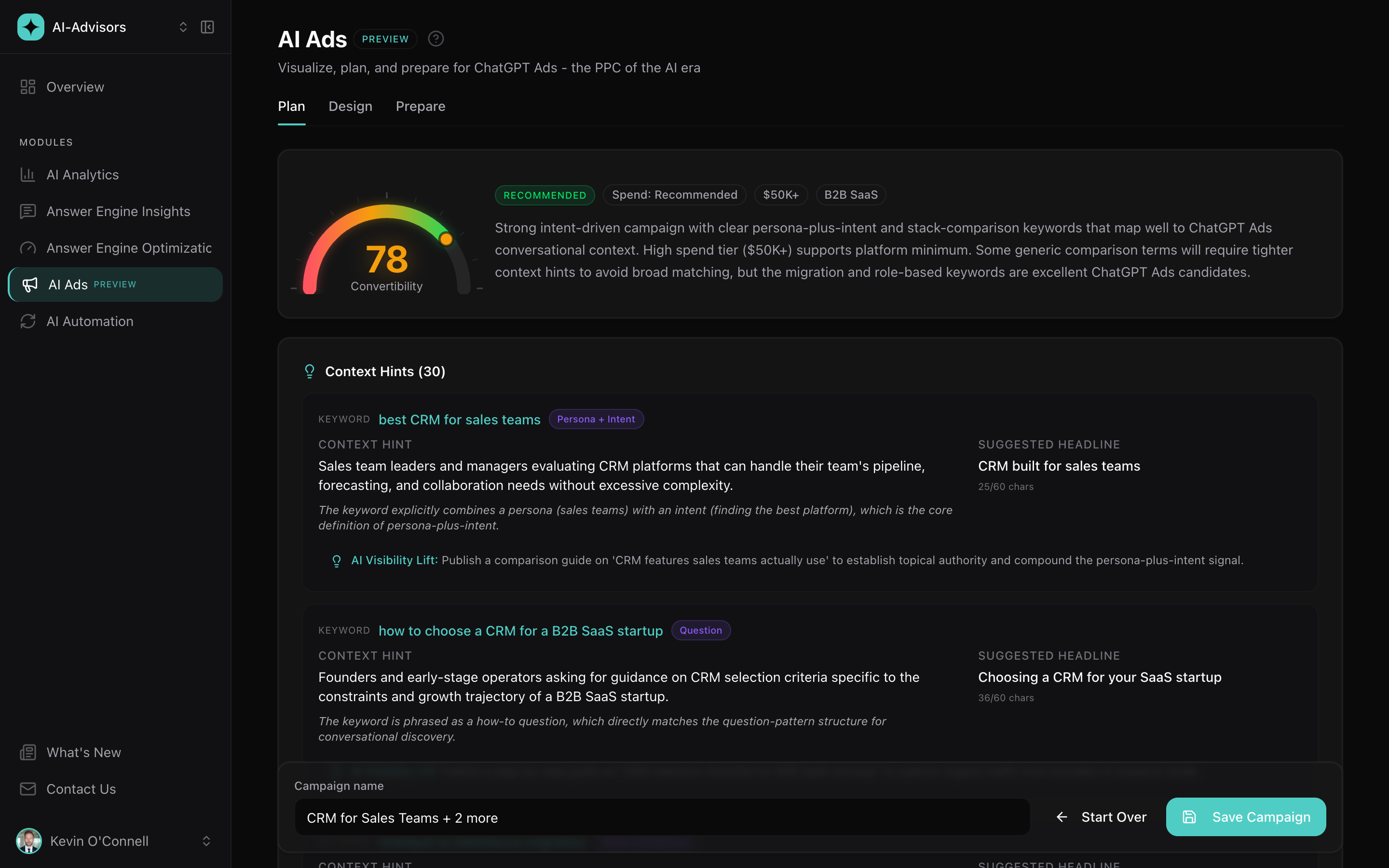
Step 5: Take the AI Visibility Lift recommendations to Content Studio
Each context hint card includes a "publish this organic content" recommendation. These are the briefs that compound your paid ChatGPT Ads with organic AI citations. Open Content Studio in a separate tab and add the recommendations as briefs. The content you ship from those briefs is what trains the platform's context model on your voice ahead of the paid campaign launch. Skipping this step works, but skips the compounding.
Step 6: Save or launch
Save keeps the converted campaign in your AI Ads Library, up to 15 saved campaigns on the Growth plan. Launch to ChatGPT Ads opens the launch form prefilled from the conversion. Review it, and with your ChatGPT Ads API key connected, AI-Advisors creates the campaign in your ChatGPT Ads account, paused, so nothing spends until you turn it on. To preview how the ad reads inside a ChatGPT conversation first, use the free ChatGPT Ads mockup tool.
✦ Want to convert your own campaigns? The Platform module is on the Growth plan ($99/month) with a 14-day trial.
Open AI Ads →When NOT to use the Platform module (yet)
Two cases. First, if you only need to evaluate whether your top 5 keywords translate at all, the Free converter is the right surface. No signup: paste up to 3 keywords and get the full report by email. Use it for exploration and discovery. The Platform module is for marketers who run conversion as a recurring workflow, not as a one-time check.
Free converter vs Platform module at a glance
- Free converter: Up to 3 keywords. No signup. Full report by email. No persistence.
- Platform module: 30 keywords plus 20 ad headlines. Full per-keyword breakdown live. Persistent saved campaigns. Launch to ChatGPT Ads, created paused. AI Visibility Lift handoff to Content Studio. Growth plan ($99/month).
- Converter in the app: Sign in with Google and connect Google Ads to import live Search campaigns. Shows what carries over and what does not, and creates campaigns paused in your ChatGPT Ads account. Open it.
Second, if your spend tier puts you below $25K and the verdict comes back "Not yet," the Platform module is signaling that small budgets read directional signal less cleanly than larger ones. The methodology, the per-keyword classifications, and the AI Visibility Lift content briefs all still apply. With the account minimum removed on May 5, 2026, you can launch the campaign at any budget above OpenAI's documented per-campaign daily minimum that varies by billing currency (US $25/day); the verdict is a quality signal, not a launch gate. Ship the AEO content this week from the recommendations either way; that's the wedge that compounds your paid placement when it runs.
The honest "Not yet" frame is intentional and structural. Most paid-conversion content stops at the headline rewrite and quietly assumes the campaign launches today. The Platform module respects the operator's reality. If you cannot run the campaign, the verdict says so. The methodology and the AEO-content-brief output stay useful regardless. That separation, between what works methodologically and what works commercially today, is the part competitors quietly skip.
Frequently Asked Questions
#What does the AI-Advisors Platform module do?
The Platform module takes up to 30 Google Ads keywords and 20 ad headlines, pasted into the converter, and translates them into a ChatGPT Ads campaign in a single LLM call. The output includes a context hint per keyword classified into one of 5 Patterns, a ChatGPT-ready headline under 60 characters, an AI Visibility Lift content brief, suggested negatives, and a translatability score with a verdict. Saved campaigns persist in your AI Ads Library, and Launch to ChatGPT Ads creates the campaign in your ChatGPT Ads account, paused.
#How is the Platform module different from the Free converter at /tools/google-ads-to-chatgpt-ads-converter?
The Free converter is the no-signup exploration surface. It accepts up to 3 keywords and emails you the full report. The Platform module handles 30 keywords plus 20 ad headlines, shows a per-keyword breakdown live, saves campaigns to your workspace, launches them to ChatGPT Ads paused, and pairs every conversion with AI Visibility Lift recommendations to take into Content Studio. To import Search campaigns straight from a connected Google Ads account, sign in to the converter in the app. Free converter is for evaluation; Platform module is for marketers shipping campaigns weekly.
#What is a Context Hint Pattern, and why are there only 5?
A Context Hint Pattern is a classification of how a buyer is mentally framing their question to ChatGPT. The 5 patterns (Persona + Intent, Question, Topic + Disqualifier, Outcome, Stack Comparison) cover the intent shapes we observed across thousands of B2B and SMB campaigns during prompt design. Constraining to 5 forces a deterministic decision: every keyword classifies into exactly one pattern, which keeps the converter output reviewable and the matching headlines tonally consistent.
#What does the "Not yet" verdict mean and what should I do?
Not yet is the converter being honest. It triggers when your final score lands below 50, either because the campaign is too generic for context-hint matching or because your spend bucket is under $25K. As of May 5, 2026, ChatGPT Ads has no account minimum (was $50K from April 13 to May 5), though OpenAI documents a per-campaign daily minimum that varies by billing currency (US $25/day, September 2026). The 0.7x spend multiplier on sub-$25K still applies as a quality signal because small budgets read directional signal less cleanly than larger ones, but campaigns can now launch without clearing an account-level spend floor. Use the converter to translate your campaign and ship the AEO content alongside.
#What plan tier do I need to use the Platform module?
The Platform module is on the Growth plan ($99/month) and above. Growth includes the converter and 15 saved campaigns; Starter does not include it. If you are paying meaningful Google Ads spend, $99 a month is rounding error against the existing media budget the converter runs on top of. A 14-day Stripe trial covers full Growth access while you evaluate.
#Does the Platform module work if I haven't connected Google Ads yet?
Yes. The Platform module works from keywords and ad headlines you paste in, so it needs no Google Ads connection. To import live Search campaigns from a connected Google Ads account instead, use the converter at app.ai-advisors.ai/tools/google-ads-to-chatgpt-ads-converter: you connect Google Ads with read-only access, it reads your Search campaigns only when you convert them (nothing syncs in the background), shows what carries over and what does not, and creates campaigns paused in your ChatGPT Ads account.
Related Reading
- ChatGPT Ads Just Opened to Every US Advertiser: What Marketers Should Do First (the May 5, 2026 launch news)
- Google Ads to ChatGPT Ads Converter (Free Tool)
- How to Convert Google Ads to ChatGPT Ads: A 2026 Migration Methodology (the discipline-led companion)
- ChatGPT Ads Conversion Tracking Is Real: What OpenAI's April 30 Privacy Policy Update Tells You About the Roadmap
- Inside the ChatGPT Ads Dashboard: A First Look at CPC Setup, Bidding, and Context Hints
- How ChatGPT Ads Work
- How Much Do ChatGPT Ads Cost?